
Three Rigs and One Phone: Watching 151 TH/s to 1.51 PH/s
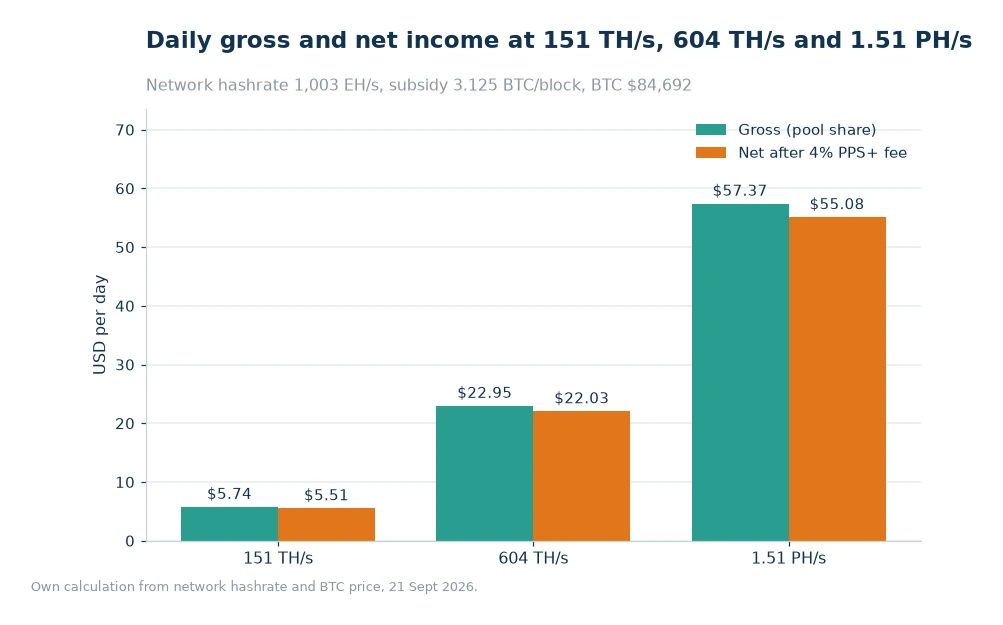
A miner with machines in three places needs one screen, not three browser tabs. The arithmetic behind that screen is simple: 151 TH/s credits 0.00006774 BTC a day, grossing $5.74 at $84,692, while 1.51 PH/s credits 0.0006774 BTC and grosses $57.37. A phone dashboard does not change either figure. It changes how fast you notice when they stop arriving.
Key takeaways
- 151 TH/s earns 0.00006774 BTC a day, or $5.74 gross and $5.51 after the listed 4% on the block-reward component.
- 1.51 PH/s is ten times that hashrate and ten times the credit: 0.0006774 BTC a day, $57.37 gross.
- An alert is only useful if the threshold is a hashrate floor you would act on, not a round number.
- The mobile build for iOS and Android reads pool data; it cannot fix a machine that has stopped hashing.
What a phone can and cannot tell you
A pool dashboard reports what the pool sees: submitted shares, credited balances, and a hashrate estimate built from those shares. It cannot report a fan bearing, a loose ribbon cable or a PSU running at its limit. That gap matters when you are away from the machines, because the first sign of trouble is usually a slow drift in reported hashrate rather than a clean stop.
Treat the app as a smoke detector, not a diagnostic tool. It tells you something changed and roughly when. The diagnosis still happens on site or through whatever remote console the hardware offers. What the phone buys you is the interval between the change and your response, and in a farm that interval is often the difference between one failed unit and a row of them running hot.
Three tiers, three credit rates
The table uses one rig class at 151 TH/s and two multiples of it. The net column applies the listed 4% to the block-reward component only; transaction-fee income is settled under the listed 2% and is left out here to keep the comparison clean.
| Hashrate | BTC per day | Gross USD | Net USD | Share kept |
|---|---|---|---|---|
| 151 TH/s | 0.00006774 | $5.74 | $5.51 | 96% |
| 604 TH/s | 0.00027097 | $22.95 | $22.03 | 96% |
| 1.51 PH/s | 0.0006774 | $57.37 | $55.08 | 96% |
Scaling is linear, which makes the table easy to extend in your head. Each extra 151 TH/s adds the same 0.00006774 BTC a day at current difficulty. The reason to keep three tiers on one screen is not the arithmetic but the comparison: a machine that is 3% down at 151 TH/s is noise, while the same percentage at 1.51 PH/s is a visible amount of daily income.
Worked example
Take the smallest tier and run the full calculation, then scale it.
- Network output per day: 3.125 BTC × 144 blocks = 450 BTC.
- BTC per TH/s: 450 ÷ 1,003,107,267 = 0.00000044861.
- 151 TH/s: 151 × 0.00000044861 = 0.00006774 BTC.
- Value: 0.00006774 × 84,692 = $5.74 gross.
- Listed 4% on the block-reward part: 5.74 × 0.04 = $0.23, leaving $5.51.
- 604 TH/s is 151 × 4: 0.00006774 × 4 = 0.00027097 BTC, or $22.95 gross and $22.03 net.
- 1.51 PH/s is 151 × 10: 0.00006774 × 10 = 0.0006774 BTC, or $57.37 gross and $55.08 net.
- Hourly at the smallest tier: 0.00006774 ÷ 24 = 0.0000028225 BTC, about $0.24, which is the size of one missed credit.
Alerts that earn their place
Two alerts cover most failures. The first is a hashrate floor per machine, set 10% below its normal reading for a full hour. The second is a missing credit at the expected hourly time. The first catches a machine that is limping; the second catches an account problem that has nothing to do with hardware.
Set both, then leave them alone for a week before adding more. A phone that buzzes six times a day gets muted, and a muted alert is worse than none because it creates the impression of monitoring. At 1.51 PH/s a 10% dip costs about $5.74 a day, so the case for fixing it quickly is easy to make; at 151 TH/s the same dip costs $0.57 and the right response may simply be to note it until the next site visit.
Getting the build onto the phone
The mobile client is published for iOS and Android, and the download page lists both. Install it from the official listing rather than a link in a chat message, then sign in with the same account that holds the mining profile; there is no separate mobile balance to reconcile. Multi-account management exists for operators running more than one setup, and it is the feature to test first if that is your case.
The ViaBTC App Download page is the place to start, and the multi-currency wallet is where credited balances sit once they arrive. Check the withdraw address in the app before you need it, not during a price move, because a typo discovered early is cheap and one discovered late is not.
When the phone is the only console
Remote monitoring works better when the physical setup is documented. Label each machine, record which port and which circuit it uses, and keep a note of its normal hashrate and draw. Then an alert that says "unit four down" turns into a phone call with a specific instruction instead of a request to look around.
Compare the app's reported hashrate with the pool's own figure during the first week. They should track within a couple of percent over an hour. A wider gap points to stale share reporting or a network problem on the miner's side, and either is worth knowing before it turns into a missed credit. The Miner Profitability Ranking is a useful second screen here, since it shows how a model's output compares with others at current difficulty, which is the context a single hashrate number lacks.
Reading the share chart without panic
Reported hashrate on a phone is an average built from shares, so it lags and it wobbles. A single low reading on a five-minute chart means little; a low reading that persists across an hour of credits means something. Judge the chart by the trend line, and judge the machine by whether its hourly credits kept landing at the expected size.
That is also why the smallest tier is a good place to learn the interface. At 151 TH/s the numbers are small enough that a missed credit of $0.24 does not demand action at two in the morning, so you can watch how the chart behaves through a difficulty change and a restart without confusing normal noise for a fault. Move the same habits to a 1.51 PH/s setup later and the readings will already look familiar.
Frequently asked questions
Does the app change what a miner earns?
No. It reads the same pool data, so 151 TH/s still credits 0.00006774 BTC a day and 1.51 PH/s credits 0.0006774 BTC a day; the app only makes the numbers visible sooner.
Which numbers should trigger an alert?
A hashrate floor per machine and a missing hourly credit. At 151 TH/s one skipped hour is 0.0000028225 BTC, roughly $0.24, and a run of them is the signal that matters.
Is the app available for both phone platforms?
Yes, the iOS and Android builds are listed on the download page, and one login can manage several mining accounts.
Install it before the next outage
Pick the two alerts, write the thresholds down, and test them by switching one machine off for ten minutes during a planned maintenance window. If the phone stays quiet, the alert is wrong and you have learned that at a convenient moment. If it buzzes, the setup is finished and the next real failure arrives with a head start.
Then keep the daily credit line in view. At 151 TH/s it is $5.51 net, at 1.51 PH/s it is $55.08, and either number is easier to defend when you can see the day it slipped.
Sources: the ViaBTC download, wallet and miner pages for client details and the listed 4%[1]. Network and price inputs read 21 Sept 2026: 1,003 EH/s, 132.76 T difficulty, 3.125 BTC per block, 144 blocks a day, BTC $84,692. Published 22 Oct 2026; all credit figures assume continuous uptime.