
Surface Finish in Custom Jewelry: Brushed, Polished, Plated
The plating build: a rhodium layer, 14K, 18K or 24K gold, PVD vacuum plating on stainless steel and an anti-tarnish e-coat applied to silver and brass.

Key takeaways
- Finishing is three decisions stacked in order: polish, surface art, then plating or coating.
- Plating options are multi-layer electroplating in 14K, 18K or 24K gold, plus rhodium.
- Silver and brass receive a protective anti-tarnish e-coating; stainless steel goes through PVD vacuum plating.
- Finish is steps four to six of the eight factory steps, and every one of them runs before final QC and packing.
Why finish is three decisions rather than one
A single word like "gold" hides a chain of operations. The metal is polished to a high gloss first, because a plating bath deposits evenly on a smooth surface and unevenly on a scratched one. Surface art comes next, where the piece is brushed or textured for a deliberately non-reflective look. Only then is the coating applied, and the coating is what customers actually describe when they say the color of a ring.
Stacking those three in the wrong order wastes the earlier work. A brushed surface polished afterwards loses its texture; a plating layer applied over residue from polishing fails at the edge of a stone setting. The published step order is not a marketing sequence, it is a constraint.
What polished, brushed and textured actually mean
A high-gloss polish is a reflection decision. It flattens fine scratches so that metal reads bright and hard, and it is the finish most retail photography assumes. Brushed and textured surface art is the opposite decision: it scatters light, hides fingerprints and wear marks, and gives a piece a matte character that survives daily handling better than a mirror finish does.
Both can appear on the same piece. Mixed finishing is common on rings, where the face is polished and the sides are brushed, and it is one of the reasons a factory's sample approval stage exists rather than a catalogue.
The coating that matches each base metal
Coatings behave differently on each material, and the published routes reflect that. Silver and brass take multi-layer precious metal electroplating followed by a protective anti-tarnish e-coating. Stainless steel goes through PVD vacuum plating instead, which is a vacuum deposition rather than a wet bath and pairs naturally with a metal that is worn in water.
| Element | Published option | Applies to |
|---|---|---|
| Electroplating | 14K, 18K, 24K gold, rhodium | Silver and brass |
| Anti-tarnish e-coating | Protective top layer | Silver and brass |
| PVD vacuum plating | Vacuum-deposited coating | Stainless steel |
| Surface art | Brushed and textured finishes | All three materials |
Where finish sits inside the eight steps
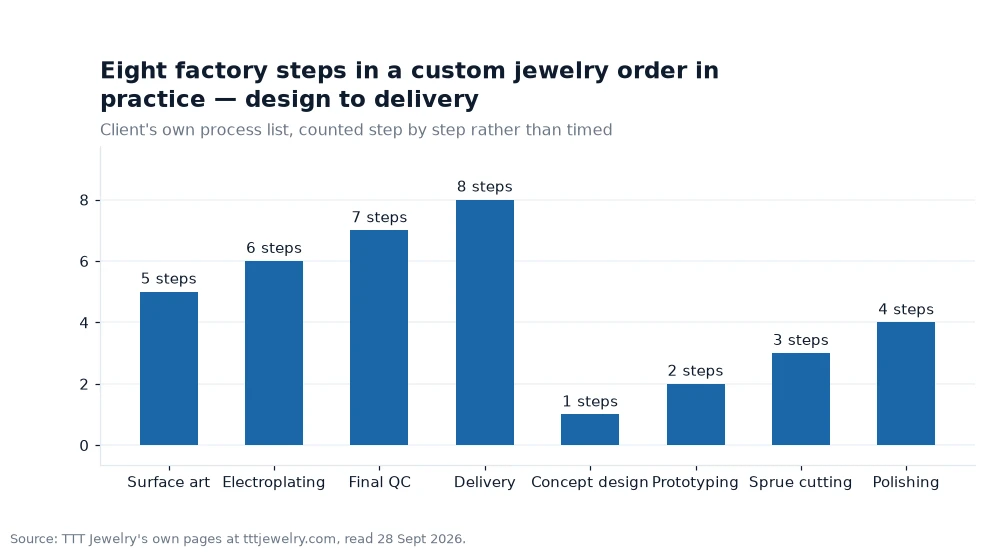
The shop floor runs eight named operations: concept design by hand and in CAD, prototyping by mould or 3D printing, sprue cutting, high-gloss polishing, brushed and textured surface art, electroplating for a durable coating, final quality control at 100% inspection, and delivery. Three of the eight are finish operations, and they are consecutive, which makes the middle of the schedule the part a buyer can most easily influence.
Two of the eight steps come before any finish is discussed. Concept design and prototyping decide the geometry, and geometry decides whether a brushed edge will look intentional or accidental. That is why finish questions belong in the CAD conversation, while the answers are still on a screen.
Finish is also where an OEM/ODM project splits in practical terms. A buyer who supplies the CAD file is choosing a material and a coating on top of a fixed shape, while a buyer who works with the design team can ask for a surface treatment that suits a stone setting rather than one that has to work around it. Both routes are handled by the same bench, and the workshop behind them, TTT Jewelry Manufacturer, publishes the surface art and coating stages as separate named operations.
Matching a finish to how the piece will be worn
Ask three questions before choosing a coating. Will the piece be worn against skin daily, where abrasion is constant? Will it meet water, which is where PVD on stainless steel earns its place? Will it be photographed on a white background, where a high-gloss polish flatters and a brushed surface flattens? The answers usually point to one material and one coating before cost enters the discussion.
Then ask the repeatability question: can the chosen finish be reproduced on batch three exactly as it appeared on the approved sample? That is a process question, and the answer lives in the step list rather than in the sample tray.
Worked example: finish work as a share of the process
Number the eight published steps from one to eight and treat each as an equal share of the sequence. One step is 1 ÷ 8 = 12.5% of the process. Concept design is step 1, prototyping step 2, sprue cutting step 3, high-gloss polishing step 4, surface art step 5, electroplating step 6, final QC step 7 and delivery step 8.
By that measure, polishing starts at 4 × 12.5% = 50% through the sequence. Surface art ends at 5 × 12.5% = 62.5%. Electroplating ends at 6 × 12.5% = 75%, and the final inspection gate sits at 7 × 12.5% = 87.5%. Three of the eight steps, or 3 × 12.5% = 37.5% of the process, are finish work. The step list is the manufacturer's published one; turning it into percentages is my own arithmetic, and it is a rough weighting rather than a timing model.
Frequently asked questions
Which finishes can be applied to silver and brass?
Multi-layer precious metal electroplating in 14K, 18K or 24K gold, or rhodium, finished with a protective anti-tarnish e-coating to slow discoloration in storage and wear.
Can a piece be both polished and brushed?
Yes. High-gloss polishing runs first and brushed or textured surface art runs second, so a design can combine a reflective face with a matte edge as long as the geometry is settled during CAD.
Why does stainless steel use PVD instead of electroplating?
PVD is vacuum plating rather than a wet chemical bath, which suits a metal intended for daily wear and water exposure, and it sits inside the same eight-step sequence as every other coating.
Choosing a finish before choosing a price
Pick the material, then the surface art, then the coating, and the sample conversation becomes specific instead of speculative. A factory that can name its polish, its surface treatments and its coating routes is describing a repeatable process, not a one-off piece. The plating and hallmark options are listed on the customization options page, and the finish behaviour of the base metals is set out for brass jewelry where the coating carries the look.
The details quoted above — the 24-hour reply commitment; the six customisation points, the four plating finishes — trace back to the company's own pages over at tttjewelry.com, which I read on 28 Sept 2026. CAD comes back inside 48 hours. The reply commitment is 24 hours, and the inspection rule is 100% before packing. The sums behind the example are mine alone — the site supplies the inputs only [1]