
Field Journal · Business, Trade & Intellectual Property
Library or Custom? What Each ODM Route Does to Your Compliance File
A library-led ODM route and a bespoke development route can both deliver a premium scent, and they produce very different paper. Library scents arrive with existing documentation and a shorter path to market; bespoke formulas arrive with a file assembled around your product, your market and your label, which takes longer but leaves the brand owning more. The right question is therefore not which route is better but which route's documentation the launch can actually support.
Key takeaways
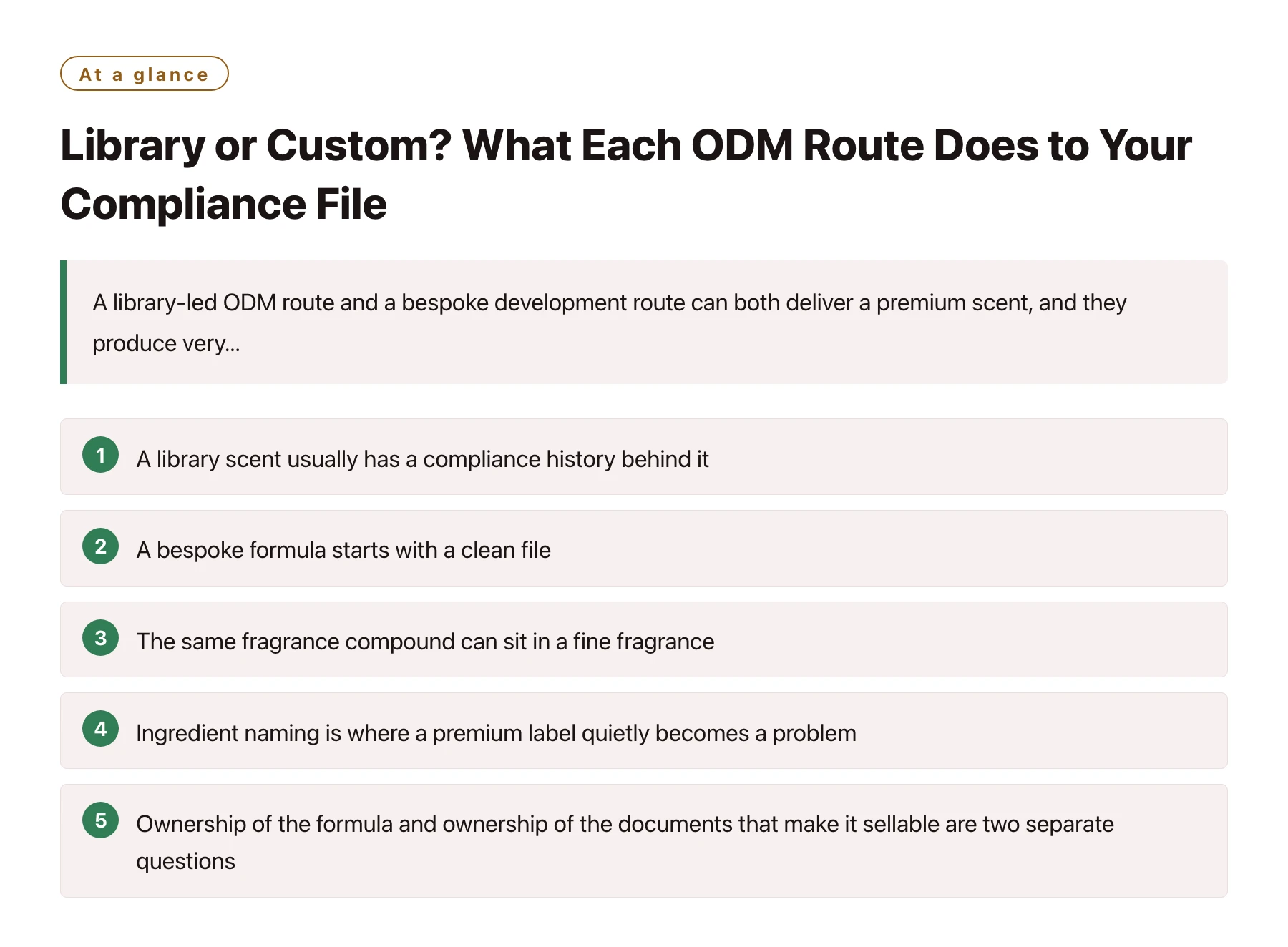
- A library scent usually has a compliance history behind it, so the work of assessing it has already been done at least once in another product and another market.
- A bespoke formula starts with a clean file, which means every layer of documentation has to be generated for your product rather than adapted from an existing one.
- The same fragrance compound can sit in a fine fragrance, a body lotion and a home product, and the restrictions differ by category, so the assessment has to name the category rather than the scent [1].
- Ingredient naming is where a premium label quietly becomes a problem, because the INCI list on the finished artwork must match the composition that was assessed [2].
- Ownership of the formula and ownership of the documents that make it sellable are two separate questions, and a development fee rarely settles both.
- The faster route is not automatically the cheaper one once labelling, testing and market entry are counted, because those costs sit outside the fragrance quotation.
Product teams tend to frame the ODM decision as creative: build something new, or choose from what already exists. That framing is real but incomplete. The two routes also produce different documentation, at different times, held by different parties, and for an export launch that difference often decides whether a launch date is met.
A library route borrows a scent that has been sold before. Its documentation exists, though it may exist in a form built for another buyer's product and another market's rules. A custom development route creates a composition for you, which means the compliance file is written from the beginning and every layer can be shaped around the finished product. Neither situation is inherently safer; they fail in different ways.
The paragraphs below compare the two routes on the paperwork they generate, then give a short sequence for deciding between them when a premium launch is already on the calendar.
The same decision, seen through documents
| Decision point | Library-led ODM route | Custom development route |
|---|---|---|
| Where the scent comes from | An existing composition, selected and then adapted in dosage for your product | A new composition written against your brief by a perfumer |
| What compliance material already exists | An assessment history from earlier uses, which must be re-checked against your category and market | Nothing yet, so the assessment is commissioned as part of the project |
| Who usually owns the formula | The manufacturer, with use rights granted to the brand | Negotiable, and often the point on which the whole agreement turns |
| How the label inputs are produced | Ingredient and allergen data are usually available early because the composition is stable | Data arrive as the formula is frozen, which pushes labelling later in the calendar |
| What happens if the scent needs to change | Dosage can be adjusted, but the recognition value of the scent is partly lost | The formula can be revised, at the cost of repeating the affected documentation |
| Typical failure mode | A scent that fits the price and the deadline but is not distinctive enough for a premium position | A scent that is distinctive and correct, delivered after the retail window has been agreed |
Read across the middle column and you are reading a route optimised for speed and evidence that already exists. Read the right-hand column and you are reading a route optimised for fit and ownership, with the paperwork cost paid in calendar time. That trade is the real ODM decision, and it is the reason a brand should decide the route before it briefs anyone on bespoke fragrance development and production.
Where the compliance file actually diverges
Both routes end with a set of documents that looks similar from the outside: a safety assessment, an allergen declaration, an ingredient list, a specification, a batch record. The difference is how much of that set was built for your product and how much was inherited.
Inherited documents are not invalid. A composition used in a fine fragrance for years carries a real history, and a manufacturer that has kept its records can move quickly because the material questions have been answered before. The risk is a mismatch of category: restrictions are set by product type and dosage, so an assessment written for an eau de parfum does not automatically describe a body mist or a candle [1]. The fix is simple and cheap, but only if someone asks.
Documents generated for your product cost more and take longer, and they are also the ones most likely to be complete. A bespoke formula forces every layer to be produced deliberately: the ingredient names are confirmed for the label, the allergen declaration is drawn from the actual composition, and the safety work names the exact bases the scent will live in.
The ingredient list is the quiet risk
Labelling is where a premium launch most often loses a week, because the artwork cannot be finalised until the ingredient declaration is fixed. Fragrance ingredient naming follows a harmonised inventory, and the name on the label must correspond to the material actually used [2]. A library scent usually arrives with this data ready, which is a genuine advantage; a custom scent produces it as the formula settles, which means the artwork schedule has to allow for it rather than assume it.
The practical test is to ask, early, for the ingredient and allergen inputs of whichever route is proposed, in the exact form the printer will need. A supplier that answers from a maintained database is organised; a supplier that promises to sort naming out later is describing a dependency it has not yet planned for.
Ownership sits on top of all of it
Formula ownership and document custody are separate negotiations. A brand can own the composition and still depend on the manufacturer's records for its safety assessment, or use a library scent it does not own while holding every document it needs to keep selling. What matters is that the division is written down and that the buyer has tested its own ability to operate with whatever it receives, which is a standard part of what to verify before signing with a fragrance manufacturer.
A short sequence for choosing between the two
- Fix the product category first.Category drives restrictions, testing and labelling, so deciding it before the scent means the compliance conversation starts from a defined position rather than a hypothetical one.
- Ask what documents already exist for any proposed library scent.A redacted example of an assessment and its label inputs tells you more than a description of the process, and it can usually be shared in a day.
- Price the bespoke route including its documentation, not just its development.Testing, assessment and labelling inputs belong in the comparison, because they are the costs that separate the two routes once the scent itself is settled.
- Compare the two answers against the retail window.If the calendar cannot absorb a full assessment cycle, a library route with a re-checked category is a defensible choice; if the position depends on being unlike everything else on the shelf, the bespoke route earns its time.
- Read the partner's own process description before the sales call.The published process is usually more detailed than a deck: Visit the website and compare how development, assessment and labelling are sequenced against what you were told verbally.
A useful discipline for a premium programme is to keep the compliance file on the critical path rather than beside it. Every launch delay that is blamed on packaging or freight can usually be traced back to a document that could not be produced until something else was frozen: the formula, the category, the label, the pack. Deciding the route early is what makes that chain predictable, and it is the kind of sequencing that separates a partner running a defined one-stop fragrance development programme from one improvising around it.
Sources
- IFRA Standards Library (International Fragrance Association) —— The IFRA Standards Library lists the restrictions the fragrance industry applies to individual fragrance ingredients, based on safety assessments; it is the reference point for compliant fragrance formulation.
- EU CosIng — Cosmetic Ingredient Database (European Commission) —— The European Commission's CosIng database of cosmetic ingredients, listing ingredient functions, restrictions and labelling requirements under EU cosmetics law.
Frequently asked questions
Is a library scent faster to launch than a custom development?
Usually, but mainly because of documentation rather than formulation. A library composition has an assessment history and label inputs that can be checked quickly, while a new formula generates those from scratch. The gap narrows if the library scent is being used in a new product category, since the assessment then has to be revisited anyway.
Can a brand own a formula developed under an ODM arrangement?
It depends entirely on the agreement. Some ODM arrangements transfer ownership of the composition for a fee, some grant exclusive use rights in a defined field while retaining ownership, and many library-led arrangements keep the formula with the manufacturer. All three are workable, provided the buyer knows which one it has signed.
What documents should be compared between the two ODM routes?
Compare the same set on both sides: the safety assessment and the category it names, the ingredient and allergen inputs in label-ready form, the specification, the retained reference arrangement, and the testing that supports stability and compatibility. A route comparison that only weighs price and lead time will miss the items that decide whether the product can be sold.
Does a bespoke scent always need more testing?
It needs testing that belongs to it, which is a different statement. A new formula in a new pack has combinations nobody has evaluated before, so compatibility and stability work is genuinely required. A library scent in a proven pack may need less new work, but the existing assessment still has to be checked against the category and dosage you intend to sell.
Light your line. Go where the maps run out.
Trail-tested ultralight flags and reflective markers, hand-painted in Boulder and shipped within 72 hours.